

This post is an edited and revised version of a talk given on the Tantra Illuminated educational platform. The subject is RASA: the nine modes of aesthetic beauty through which emotion is transformed into the sublime expansive experience of wonderment. The podcast version of this talk is here.
Among the wider community of Sanskrit scholars, those who are not specifically studying Shaivism or Tantra, the great Tantrik master Abhinavagupta is better known as a philosopher of aesthetics. That is to say, a Sanskritist is more likely to have heard of him in relation to the philosophy of aesthetics (alaṅkāra-śāstra), the study of the experience of beauty and what makes something beautiful. Abhinavagupta wrote extensively on this topic, focusing on the artistic disciplines of poetry, dance, and drama. He wrote a huge commentary on the Nāṭya-śāstra, which is the foundational work of dramaturgy (the study of theatrical performance), and also wrote a commentary on the great Dhvanyāloka, a book on the science of poetry. I say science because it was treated as such in premodern India, with a lot of precision. Abhinava’s commentary is called the Lochana; he wrote this Dhvanyāloka-lochana, this comprehensive study of beauty in poetry, and in the context of these two works, he elaborates what we sometimes call Rasa theory, the theory of aesthetic beauty in nine types, nine rasas, as they’re called. ‘Rasa’ literally means savor or flavor or juiciness or sap, but in this context it means something like aesthetic sentiment, the experience of artistic beauty. And what is surprising about this list of nine Rasas is that it includes some that we wouldn’t necessarily expect, and in this way it becomes a spiritual teaching as well.
Before I get there, let me talk a little bit about the definition of Rasa. My teacher, Somadeva Vasudeva, who I studied with both at Oxford and at Berkeley, wrote this:
Rasa is the experience one has viewing artwork that is moving or impactful. It refers to the experience itself. Therefore, what we call Rasa is not located in the work but in the viewer. Rasa does not refer to the everyday worldly emotions of love, sorrow, humor, and so on, but to their transformation into aesthetic sentiment (that is to say, the experience of beauty). The transformation of worldly emotion into aesthetic sentiment, bhāva into rasa, occurs when we become keenly aware of the worldly emotion in our own hearts in a manner in which it has become somewhat depersonalized or universalized. This very act of awareness, in which we witness the arising of a basic emotion as a source of beauty entails its transformation into aesthetic sentiment. This act of awareness and synchronous transformation is Rasa.
Now, Somdev writes quite a bit more on this topic in his introduction to his translation of the magnificent play, The Recognition of Shakuntalā, sometimes thought to be the greatest play ever written in the Sanskrit language, certainly a profoundly poignant play that begins as a kind of romantic idyll and ends in a somewhat ambiguous, bittersweet fashion, and thus could be said to be more reflective of real life than a simple romance would have been. In his introduction to his translation, published in the Clay Sanskrit Library, Somdev has this to say:
Imagine you find yourself going to see a performance of a great play, a performance of Romeo and Juliet. You are in the right mood for the play, no mundane worries preoccupy your mind, you have agreeable company, and the theater, the stage, the director, and the actors are all excellent, capable of doing justice to a great play. Your seat in the theater is comfortable and gives an unobstructed view. [Somdev mentions these factors to indicate that the setting is right for an experience of beauty, the factors are in place, and you're undistracted.] The play begins, and you find yourself drawn into the world Shakespeare is depicting. The involvement deepens to an immersion, where the ordinary everyday world dims and fades from the center of attention, and you begin to understand and even share the feelings of the characters on stage. Under ideal conditions, you might reach a stage where you begin to participate in some strange way in the love being evoked. Now, if at that moment you were to ask yourself, Whose love is this? A paradox arises. It cannot be Romeo’s love for Juliet, nor Juliet’s love for Romeo, for they are fictional characters. It cannot be the actors’ love, for in reality they may despise one another. It cannot be your own love, for you cannot love a fictional character, and you know nothing about the actor’s real personalities, being veiled by the role that they effectively assume. And for the same reasons, it cannot be the actors’ love for either you or the fictional characters. So it is a peculiar, almost abstract love without immediate referent or context. A Sanskrit aesthete (an appreciator of artistic beauty) would explain to you that you are at that moment relishing your own fundamental emotional state (sthāyi-bhāva) in its modality known as passion, which has been decontextualized by the operation of sympathetic resonance (hṛdaya-saṃvāda) and heightened to become transformed into an aesthetic sentiment (rasa) called the śṛṅgāra-rasa, the romantic sentiment.
That last paragraph had a number of technical terms. I just want to highlight the term sympathetic resonance, which in a literal translation would be “the conversation of the heart” (hṛdaya-saṃvāda), used in a technical sense to mean a sympathetic resonance with that which the artists are depicting. Somdev goes on to say: “this aesthetic sentiment is a paradoxical and ephemeral thing that can be evoked by the play, but is not exactly caused by it, for many other spectators may have felt nothing at all during the same performance. You yourself, seeing it again next week under the same circumstances, might experience nothing. It is, moreover, something that cannot be adequately explained through analytic terms; the only proof for its existence is direct personal experience.”
A 14th-century literary critic writing in Sanskrit (Viśvanātha of Odisha) discussed how amazing this actually is. We probably take it for granted, but it’s amazing that we can have this incredibly profound experience with artistic work that evokes something very deep in us. I won’t cite the whole passage, but that 14th-century literary critic (cited and translated by Somdev) says, in part: “It cannot be made known, for its existence cannot be separated from its experience. Since it depends, in essence, upon a mysterious aggregation of factors, it cannot be a [simple] effect. And when not perceived it does not even exist, nor does it exist presently as a knowable, since it is different from any effect [or anything that can be pinned down]. . . . it is not imperceptible, since it can arise from words, yet its manifestation is not perceptible. Therefore, connoisseurs should truly regard it as non-ordinary, and it is, moreover, a blissful experience.”
There is a joy or a bliss in this experience of aesthetic sentiment. Now how do we come to the spiritual teaching here? Well, we learn through Rasa theory and through our own experience of art that we’re capable of experiencing profound beauty in circumstances that, if we were to take them personally, would be profoundly distressing. For example, whether it’s Shakespeare or some other great author, we’re more than capable of experiencing beauty in tragedy. If we were taking that tragedy personally, as something that happened to me, it would just be upsetting. For most of us, it would be difficult to experience the beauty in that grief, and likewise, we find certain other life experiences, like fear and repulsion, to be just distressing. We miss the opportunity to experience beauty in them, but the Rasa teaching shows us that it is possible. I’ll explain.
The most common misunderstanding is that the Rasas are emotions. There’s a beautiful album called Navarasa by some great Eastern and Western musicians collaborating together. This trio, Yorkston, Thorne, and Khan called their album Navarasa, mistranslating nava-rasa as “nine emotions.” It’s a beautiful album with nine tracks attempting to evoke the different rasas, but it’s also an example of this common misunderstanding, taking the Rasas to be emotions. That's precisely what they aren’t, because they are emotion transformed into esthetic sentiment. When the erotic or romantic emotions are transformed into aesthetic sentiment, into an experience of beauty, we call that śṛṅgāra-rasa. Heroic or inspiring feelings transformed into aesthetic sentiment is called vīrya-rasa. You know those movies where it’s about a triumph of the human spirit, say Billy Elliot, one of those movies where the hero finally is able to triumph over their obstacles, and find their own place in the world — if it's sufficiently well done, such that you are caught up in the experience, the triumph of this fictional character becomes your triumph. It taps into all the moments of of triumph you’ve had in your life, and your potential for further such moments, so you feel inspired; that’s the vīrya-rasa.
Then there’s the astonishing Rasa, the adbhuta-rasa. That’s the experience of amazement or wonder transformed into aesthetic sentiment. We’ve all seen movies we found mind-blowing. (Of course a work of art can mix more than one Rasa, but to be well done it needs to have a dominant rasa and a subordinate rasa at most, not a whole bunch of them, because then it wouldn’t be focused enough to evoke the experience fully.) The compassionate Rasa, I call it the tear-jerking Rasa, that's kāruṇya, from the word karuṇā, which means mercy or pity or compassion. When feelings of grief are transformed into the compassionate aesthetic sentiment, into the experience of beauty-in-sadness, that’s kāruṇya-rasa. So you might be weeping, absolutely sobbing over some movie or play or poem, but it’s beautiful. You may not have the same experience of beauty for sad events in your own life. The whole point of this teaching is that the difference here is precisely just this self-referencing ego that takes things personally — that if you could even temporarily suspend this self-referencing ego, you would have the same capacity to experience beauty in the tragic events of your own life as you do in viewing the most beautifully done tragic film or play or poem.
Now let’s come to the most unexpected rasas. The wrathful rasa, the raudra-rasa is when feelings of anger are transformed into aesthetic sentiment. Anger becomes divine wrath, an experience of wrath-as-beauty. It still that has the energy of anger, but it’s been transformed into angry beauty, as it were. Even more unexpected: the terrifying Rasa. When the experience of fear is transformed into beauty. For example, the video game Silent Hill 2 is not only very frightening but also extremely beautiful (your mileage may vary — remember, the factors involved are not just in the work but also in the viewer). Even the disgusting, the repulsive, can become an experience of beauty. When repulsion is transformed into aesthetic sentiment, that's the bībhatsa-rasa. Harder, perhaps, for us to find examples of this . . . I don't know if this is an example, but one artist had a piece in the museum that caused a lot of controversy: it was called Piss Christ, and it was a crucifix, Jesus on a cross, in a bucket of urine. Not my kind of art exactly, but for the right person at the right time, maybe a person who really needed to break free of their Christian conditioning, seeing the crucifix in the bucket of urine might be a thrilling experience — they might be disgusted, but also enlivened by that experience.
The comedic rasa, hāsya-rasa, is when laughter and fun is transformed into aesthetic sentiment. Let’s be clear, we’re not here talking about anything that makes you laugh, any funny movie — it has to be amusement elevated into an experience of beauty. You are still laughing, but you’re also moved. Because we can all think of silly movies, we laugh at them, but were we moved in some way? Were we taken outside of our ordinary self to something more exalted, more expansive through comedy? (Perhaps The Truman Show is an example.)
The last of the nine Rasas is the śānta-rasa, the peaceful or tranquil Rasa. Abhinava Gupta argues for the validity of this ninth Rasa, which was not universally accepted before him. He didn’t invent it, but his arguments in favor of it made it accepted among Indian aestheticians. You might be surprised that he needed to argue for it, but there was already a set of eight that everyone agreed on, and only some aestheticians said there should be a ninth, the śānta-rasa — but it wasn't until Abhinava Gupta argued for it that people accepted it. This Rasa is when a work of art evokes a tranquillity in you that becomes sublime. It transforms world-weariness into tranquil, peaceful beauty.
LIST OF RASAs:
passion-and-desire-experienced-as-beauty is the śṛṅgāra-rasa (‘romantic’ rasa)
strength-of-will-experienced-as-beauty is the vīrya-rasa (‘heroic’ rasa)
disgust-experienced-as-beauty is the bībhatsa-rasa (‘repulsive’ rasa)
anger-experienced-as-beauty is the raudra-rasa (‘wrathful’ rasa)
amusement-experienced-as-beauty is the hāsya-rasa (‘comedic’ rasa)
astonishment-experienced-as-beauty is the adbhuta-rasa (‘marvellous’ rasa)
fear-experienced-as-beauty is the bhayānaka-rasa (‘frightful’ rasa)
grief-experienced-as-beauty is the kāruṇya-rasa (‘compassionating’ rasa)
letting-go-experienced-as-beauty is the śānta-rasa (‘peaceful’ rasa)
And here’s the same list, with Somadeva Vasudeva’s slightly different translations:
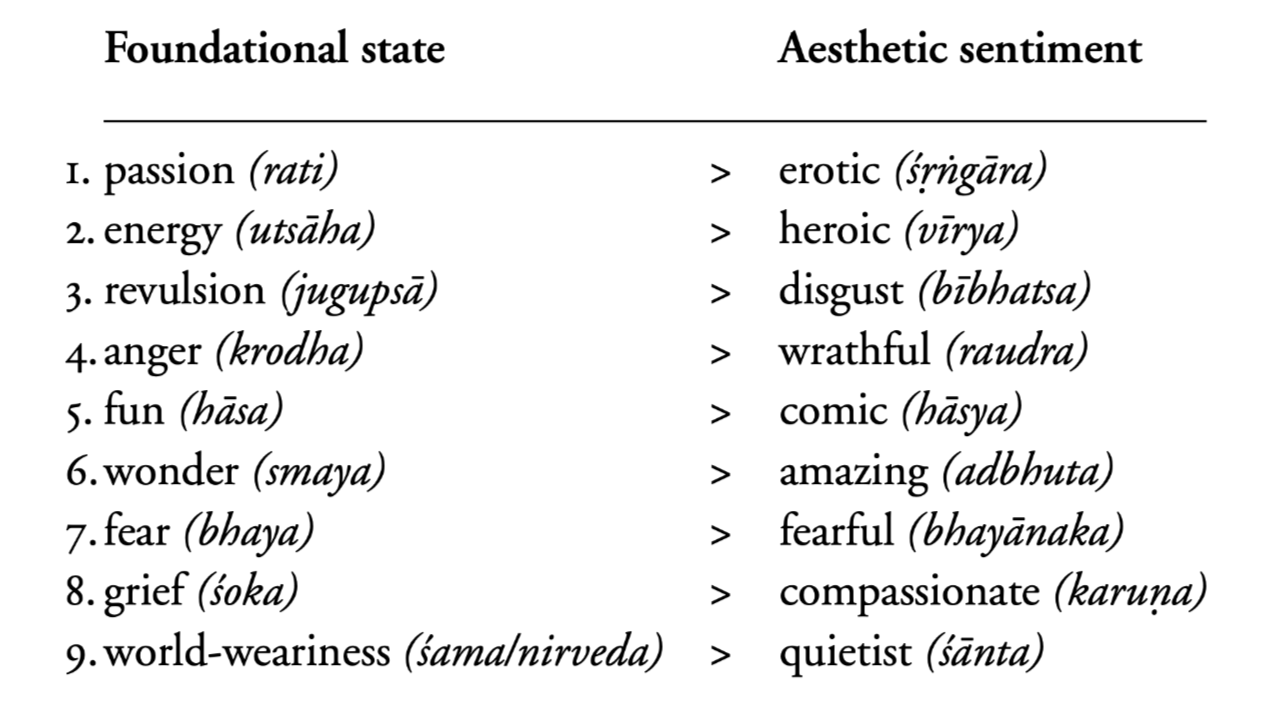
In all nine modalities, you are touching the sublime: that’s what makes it rasa. Otherwise, it’s just emotion. Not to denigrate emotion per se, but emotions come and go, they don’t define who we are. When we touch into the sublime, then we touch the depths of our real nature.
Lastly, as many of you know, the Svacchanda-tantra contains a famous quote:
>> nāśivaṁ vidyate kvacit — “Nothing exists which is not Shiva.”
Then the question becomes: how do we define Shiva? Here, the word is being used in a very similar way to the word ‘God’—if we are talking about God in a nondual sense, rather than as a supernatural persona. Nothing exists which is not God. But even then, we need to ask: what is the nature of this God?
I have long argued that in this tradition, ‘God’ does not mean ‘good’ in any moralistic sense. Because of this, the tradition escapes the problem of theodicy that Christianity and other monotheistic religions face—namely, theologies that claim God is a separate entity who is wholly good and all-powerful. If that is your theological premise, you face a monumental problem when confronted with suffering, much of which appears meaningless.
The classic argument, as articulated by figures like Stephen Fry, asks: why would a completely good and all-powerful God allow such a thing to exist as bone marrow cancer in children? Why create a context where such immense suffering is possible for those who haven't even had a chance to experience life? This is the problem of evil.
This tradition does not have that problem because it never argues that God is a separate, supernatural persona who is purely ‘good’. Instead, God is defined as consciousness itself, and the universe is a play of consciousness—cit-śakti-vilāsa. This ‘play’ operates in both senses of the word: playful like a game, but also dramatic like a theatrical play. This world is a play of consciousness on the level of saṃsāra (the worldly drama) and on the level of nirvāṇa (the playfulness of liberation). Of course, these two levels are not entirely separate except within an individual’s personal experience/perception.
This is why we see Shiva dancing in the cremation grounds—dancing in the place of death and sorrow, where jackals gnaw on the bones of deceased relatives. Even there, Shiva is dancing joyously. This represents an actual celebration of both life and death, birth and dying, growth and decay, joy and sorrow. It is an active celebration of all of it, rather than a meek acceptance, which would be too feeble.
So, “nothing exists which is not Shiva.” The Sanskrit word śiva literally means ‘a blessing.’ Therefore, every experience, every moment, and everything has the potential to be a blessing—it has a potential blessing energy within it. And it is up to the observer to extract that energy, just as we see in Rasa theory.
In Rasa theory, you cannot be entirely passive. The process of experiencing beauty might happen of its own accord, but you must bring something to it. No matter how incredible the art is, it cannot force you to experience beauty if you are closed off. You must bring your presence and your open heart.
In Sanskrit, a connoisseur of great art is called a sahṛdaya. This literally means ‘someone with heart’—someone with an open heart. This is the person who can truly experience beauty.
Isn’t it interesting, then? Nothing exists which is not Shiva; nothing exists which does not have the potential for blessing or beauty. This is what the tradition is teaching us. It is about interrogating these beautiful concepts, rather than just taking them at face value. If you simply say “nothing exists which is not Shiva” without understanding what Shiva represents, the statement remains meaningless. This divine consciousness that we all are has the capacity to experience blessing and beauty in anything. Whether we do so or not is another question entirely, but according to this tradition, there is no experience that cannot become a blessing.
This is a beautiful point of correspondence between the Jewish and the Shaiva traditions. In both, we say: “let it be for a blessing”—iti śivam, “may it be for a blessing.” Anything can be a blessing, and the experience of beauty itself is already a blessing.
Abhinavagupta says that the highest version of beauty is camatkāra, which means an experience of wonder that completely obliterates everyday concerns and the conditioned, thinking mind. In that state, you are simply lost in blissful wonder. That is not only what art has the capacity to evoke; it is what life itself has the capacity to evoke. We are those unique beings who can experience camatkāra, and that is what makes us extraordinary.
In modern scientific materialism, humans are often depicted as insignificant specks on a rock spinning randomly through space with no inherent meaning or purpose. But great philosophers, whether spiritual or not, argue that this is nonsense. It is nonsense because we are not aware of any other creatures in the universe that possess this capacity for camatkāra—this capacity for sublime wonder and joy, which is essentially the universe savoring itself. How could it be anything other than that? Since we are part of the universe, we function as its sensory organs. Through us, the universe savors itself blissfully. That makes us, and all other sentient creatures capable of doing the same, some of the most important beings in the universe. That is not an exaggeration.
Now Abhinava Gupta may have had a past life in our time because he has these metaphors that are extraordinarily modern . . . they didn't have electricity in his time, and yet he says something like this: imagine that there’s a room that’s completely dark, but in this room is the most incredible work of art anyone has ever seen, only you haven’t yet seen it. This incredible work of art is invisible to you in a darkened room, and all at once, all the lamps of that room are lit at the same time. The image he’s trying to get to is someone suddenly flicks on the lights. All the lamps are lit at the same time, and you suddenly see that work of art: that's the moment of camatkāra, the beauty and wonder is there before you have a thought about it, before you have an analysis, or a narrative, or an autobiographical story, before you start composing the social media post that you’ll make about it later, before all of that there’s pure wonder and aesthetic rapture, he says. This is possible in countless experiences of everyday life as well. So he says that the experience of art points us to spirituality, whether we realize it or not.
POSTSCRIPT:
What an opportunity for a contemplation here. I would say that we could compare the story of your life, of any of our lives, to a novel in more than one way. The story you would tell about your life, however well you tell it, is fictional, just like a novel, precisely because the events of a human life are far too numerous to describe all of them. So we pick and choose, but do we pick and choose at random? No. If you’re going to tell the story of your life, you pick certain events that you regard as specific, and in other words, you end up weaving a narrative that reflects who you think you are, but someone else could select different events from the same timeline, and weave a very different narrative, couldn't they? So, whether your narrative depicts yourself as someone awesome, someone amazing, or someone troubled, who struggles in life, whatever, it reflects your preexisting biases. Because again, if we had all the events of your life to play with, someone could cherry pick from those and make a completely different narrative from the one you might prefer. Whether you exalt yourself or demean yourself, there’s going to be countless other narratives that would be different. So, any story you would tell about your life is, I would argue, equally fictional to a to a great novel — and I say a great novel because a great novel by a great writer does give you insight into human nature. It's meaningful, even though it's fictional. You read such a novel, and you do get more insight into human nature, just like the story that you would tell about your life would give us some insights (at the very least about your psyche), even though it’s a fiction. The story of your life is also like a novel in the sense that there’s so many opportunities for Rasa, for the experience of beauty. They get missed insofar as you take things personally. All you have to do is compare the way you feel exalted into the realm of the sublime by a work of art depicting sad events versus the sad events of your own life, which oftentimes just make you depressed and grumpy and complain-y, which is in a way the opposite of the sublime experience of beauty. You can make your life into art, creative beauty, without even changing what you do, but rather changing how you engage with it, what you bring to it.