
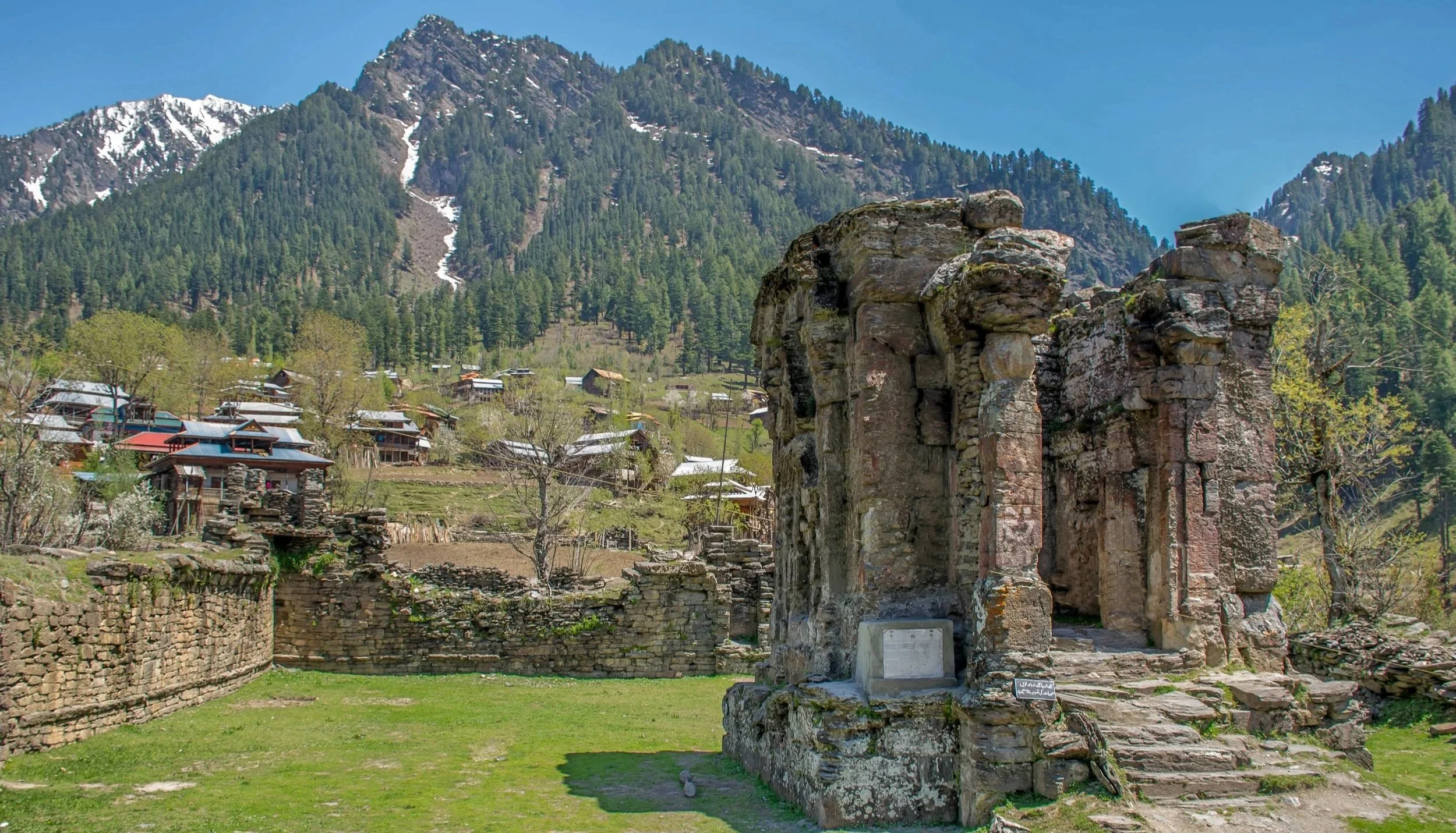
The Śiva-sūtra is a Tantrik text of 77 aphorisms: mysterious and powerful terse phrases that point us beyond the mind and deep into our own conscious experience, unveiling unguessed possibilities within it. These teachings were revealed by the awakened ones of the Śaiva tradition, the siddhas and yoginīs who lived in the mountains on the east side of the Valley of Kashmīr in the ninth century.
The Śiva-sūtras were gathered and compiled by a great master named Vasugupta, who, the tradition says, was one “whose heart had been purified by the spiritual transmissions that he had received from numerous Śaiva Yoginīs and Siddhas.” For more on the origin stories of these sūtras, see this post.
Such aphorisms were never meant to be understood on their own; they were designed to require the explanation of a qualified teacher, for the tradition of classical Tantra is and always was primarily oral in nature. The transmission from teacher to student through living language the student can understand is sacred; it is the heart of the Tantrik tradition.
In this day and age people seek teachings that are easily understood. But such teachings can only be superficial. Are you not curious to explore the depths of consciousness through these sūtra-transmissions, crafted in a far distant time and place yet pointing to that which is universal in human experience and fundamental to the nature of reality?
These teachings are not self-help platitudes but pulsations of pure awakened awareness. They are for those who want a radically transformed experience of life itself.
Here are the final 45 sūtras of the text (comprising Chapter Three), in my translation. First I present them on their own, then a second time with notes from the Sanskrit commentaries on the text.
NOTE: here I present only the sūtras (with some notes of explanation), lacking the full commentary needed to truly understand these sublime teachings. Detailed commentary in the form of teaching videos (one per sūtra) can be found on my learning portal Tantra Illuminated.
Chapter Three: vibhūti-spanda
(the vibration of powers)
3:1 ātmā cittam : The mind is the [conventional] self.
3:2 jñānaṃ bandhaḥ : [The] cognition [of such self] constitutes bondage.
3:3 kalādīnāṃ tattvānām aviveko māyā
Māyā is the lack of discernment regarding the tattvas from kalā (limited power of action) to Earth.
3:4 śarīre saṃhāraḥ kalānām
Dissolution of the limited powers in the body.
3:5 nāḍīsaṃhāra-bhūtajaya-bhūtakaivalya-bhūtapṛthaktvāni
Retraction of the channels, conquest of the elements, isolation from the elements, and separation of/from the elements.
3:6 mohāvaraṇāt siddhiḥ
Attainment [arises] due to covering (that is, restraining) delusion. (Bh) / OR:
Magical power [arises] because of the veil of delusion. (Kṣ)
3:7 moha-jayād anantābhogāt sahaja-vidyā-jayaḥ
One attains innate wisdom through the conquest of delusion, which [gives access to] the infinite expanse.
3:8 jāgrat dvitīya-karaḥ
Waking is the second ray. / The waking state is second-hand.
3:9 nartaka ātmā : This self is an actor.
3:10 raṅgo’ntarātmā : The ‘inner body’ is its stage.
3:11 prekṣakāṇīndriyāni : The senses are the spectators.
3:12 dhī-vaśāt sattva-siddhiḥ
Through the influence of the higher mind, there is the attainment of pure lucidity.
3:13 siddhaḥ svatantrabhāvaḥ
The state of freedom is [already] attained. /
A siddha is one whose bhāva is independent freedom.
3:14 yathā tatra tathānyatra : As it is there, so it is elsewhere.
3:14:2 (only in Bhāskara): visarga-svābhāvyād abahiḥ-sthites tat-sthitiḥ
Because its essential nature is emission, that which is not external exists as if it is.
3:15 bījāvadhānam : Careful attention to the Seed.
3:16 āsana-sthaḥ sukhaṃ hrade nimajjati
Remaining easefully in one’s seat, one sinks deep into the Lake [of Awareness].
3:17 svamātrā nirmāṇam āpādayati
He [Śiva] brings about creation by means of his Mother. (Bh) /
He [the Yogī] brings about creation by means of an aspect of himself. (Kṣ)
3:18 vidyā-vināśe janma-vināśaḥ (Bh.) / vidyā ’vināśe janma-vināśaḥ (Kṣ.)
When limited knowledge is destroyed, there is no more rebirth. /
When there is a lack of destruction of pure knowledge, there is no more rebirth.
3:19 kavargādiṣu māheśvaryādyāḥ paśu-mātaraḥ
The [eight] Mothers of the bound soul, Māheśvarī and so on, are in the classes of consonants beginning with the velar [class].
3:20 triṣu caturthaṃ tailavad āsecyam
The Fourth should be poured, like oil, into the three.
3:21 magnaḥ svacittena praviśet : Merged, one should enter with one’s mind.
3:22 madhye ’vara-prasavaḥ : The lower [state] arises in the middle.
3:23 prāṇa-samācāre sama-darśanam
When the breath becomes even & equal, [one may have] the vision of equality.
3:24 mātrā-svapratyaya-saṃdhāne naṣṭasya punar utthānam
When one’s perception unites with its objects, that which had vanished arises again.
3:25 śiva-tulyo jāyate : He becomes equal to Shiva.
3:26 śarīra-vṛttir vratam
The activity of the body is his sacred observance. /
The maintenance of the body is the sacred vow.
3:27 kathā japaḥ : His or her speech is japa.
3:28 dānam ātma-jñānam
His or her ‘charitable donation’ is the knowledge of the Self.
3:29 yovipastho jñāhetuś ca / yo ’vipastho jñāhetuś ca
Residing in the source, the highest [aspect] of the universe, he brings about wisdom. (Bh) / He who resides in the protectors of the sheep [i.e. the Wheel of Energies] is the cause of knowledge. (Kṣ)
3:30 svaśakti-pracayo’sya viśvam
The multitude of his powers constitute the universe.
3:31 sthitilayau : Stasis and dissolution.
3:32 tatpravṛttāv apyanirāsaḥ saṃvettṛ-bhāvāt
Even during the activities of those processes, there is no elision of the self, because of its status as the Experiencer.
3:33 sukhāsukhayor bahir mananam
The feelings of pleasure and displeasure are ‘external’.
3:34 tadvimuktas tu kevalī : Liberated from them, one is free.
3:35 moha-pratisaṃhatas tu karmātmā
But one who is engulfed by delusion [remains] a ‘karmic self’.
3:36 bheda-tiraskāre sargāntara-karmatvam
When duality is discarded, there is the creation of another world.
3:37 karaṇa-śaktiḥ svato’nubhavāt
The power of creative activity [arises] from one’s own experience.
3:38 tripadādyanuprāṇanam
That which is primordial vitalizes the three states.
3:39 citta-sthitivac charīra-karaṇa-bāhyeṣu
As in the [internal] state of mind, so in the body, senses, and external things. (Kṣ) /
As with the stability of the mind, so it is with the body, the senses, and external objects. (Bh)
3:40 abhilāṣād bahirgatiḥ saṃvāhyasya
The outward movement of that which is to be carried occurs due to desire.
3:41 tadārūḍha-pramites tatkṣayāj jīva-saṃkṣayaḥ
Then, when one has ascended to true perception, that [craving] is destroyed, because of which the individual soul ceases to exist.
3:42 bhūta-kañcukī tadāvimukto bhūyaḥ pati-samaḥ paraḥ /
bhūta-kañcukī tadā vimukto bhūyaḥ pati-samaḥ paraḥ
[One who is] clad in the cloak of the elements is then not free; but, like the Lord, he becomes supreme once more. (Bh) /
Then, the one clad in the cloak of the elements is released [from it]; he becomes supreme once more, like the Lord. (Kṣ)
3:43 naisargikaḥ prāṇa-saṃbandhaḥ : The link with the vital breath is natural.
3:44 nāsikāntarmadhya-saṃyamāt kimatra savyāpasavya-sauṣumneṣu
[This link is realized] through saṃyama on the middle of the interior nasal cavity—so what is the need here for the right and left [channels], or [even] the suṣumnā?
3:45 bhūyaḥ syāt pratimīlanam : There shall be re-absorption once again.
* * *
Sutras with explanatory notes (work in progress)
Bh = Bhāskara (earliest commentator); Kṣ = Kṣemarāja; V = Varadarāja (who usually follows Kṣ closely)
3:5 nāḍīsaṃhāra-bhūtajaya-bhūtakaivalya-bhūtapṛthaktvāni [bhūta-siddhayaḥ (Bh)]
Retraction of the channels, conquest of the elements, isolation from the elements, and separation of/from the elements.
Kṣ: prāṇāyāma -> dhāraṇā -> pratyāhāra -> unmanā/samādhi
Bh: nāḍīsaṃhārāt, ṣaḍguṇāḥ (due to withdrawing the channels, the six qualities arise): stability, flow, heat, movement, emptiness, and reversal
3:6 mohāvaraṇāt siddhiḥ
Attainment [arises] due to covering (that is, restraining) delusion. (Bh) / OR:
Magical power [arises] because of the veil of delusion. (Kṣ)
Kṣema says that yogic practice in the usual way (prāṇāyāma -> samādhi plus deha-śuddhi and bhūta-śuddhi) may confer siddhi but does not necessarily grant insight into reality, whereas doing these practices in the more subtle, interiorized manner as taught in the Netra Tantra brings about immersion into the ultimate nature of reality (paratattva-samāveśa).
3:7 moha-jayād anantābhogāt sahaja-vidyā-jayaḥ
One attains innate wisdom through the conquest of delusion, which [gives access to] the infinite expanse.
Bh: Delusion still existed in the previous stage (3.6), now we address what happens when it is conquered. moha-jayaḥ = nityam asaṃkucita-cid-gateḥ suprabuddhatā (complete and total awakening occurs when awareness is eternally uncontracted); this occurs due to its innate luminosity. From that infinite expanse, the light of one’s own nature dawns clearly. This light is innate wisdom. The infinite is termed an ‘expanse’ because its real nature is perfectly full.
Kṣ: two stages, ātma-vyāpti -> śiva-vyāpti. “Having let go of the principle of the self (ātma-tattva), one unites with the principle of [spontaneous] Wisdom (vidyā-tattva).” Sahaja-vidyā-prāpti = śiva-vyāpti
3:9 nartaka ātmā : This self is an actor.
Bh: Vibrating in accord with its own nature, the Self manifests in all respects by becoming ‘possessed’ by the rasa corresponding to each [relevant] mental-emotional state [that arises] and then behaves playfully in accordance with that [rasa].
Kṣ: this performance depends on the [at least partial] concealment of one’s innate nature; he manifests these roles on his own screen/canvas (svabhitti); it is a play of one’s own vibration (sva(pari)spandalīlā); you maintain [many] nested roles (kośa)
According to Bhaṭṭa Nārāyaṇa [Śivacintāmaṇi vs. 59]: “What dramatist other than you, O Śiva, is able to introduce and conclude the theatrical performance of the three worlds (trailokya-nāṭaka), which contains the [dramatic] ‘seed’ for all the states of being that have been produced?”
3:10 raṅgo’ntarātmā : The ‘inner body’ is its stage.
Bhās: antarātmā = puryaṣṭaka; Kṣe: antarātmā = jīva
3:11 prekṣakāṇīndriyāni : The senses are the spectators.
Bh: Cidātmā is [ever] svatantra and suprabuddha; due to its strength/capacity, the senses function. So they cannot conceal the real nature of the dancing Lord of Consciousness.
3:12 dhī-vaśāt sattva-siddhiḥ
Through the influence of the higher mind, there is the attainment of pure lucidity.
V prefaces this with the statement: “For the yogī whose circle of senses have become spectators…”
Dhī = tāttvika-sva-cid-rūpa-vimarśa-kuśalā matiḥ, “a mind skilled in reflecting on the nature of one’s awareness as it really is” . . . “through its power, there is attainment of sattva, viz., the scintillating spanda that is inward-turning.” (Varada)
3:13 siddhaḥ svatantrabhāvaḥ
The state of freedom is [already] attained. /
A siddha is one whose bhāva is independent freedom.
Since it is taught by venerable Śrīnātha: “That supreme dynamism that rests in her innate energy of freedom is Śrī Kālī.” (quoted by Kṣema)
3:14 yathā tatra tathānyatra : As it is there, so it is elsewhere.
Varada: freedom & autonomy—having the all-inclusive ‘I’ as its nature—that has become clear in the body aligned with essence-nature (svābhāvika-deha) becomes likewise clear in all other bodies for the yogī who is yoked.
3:14:2 (only in Bhāskara): visarga-svābhāvyād abahiḥ-sthites tat-sthitiḥ
Because its essential nature is emission, that which is not external exists as if it is.
Bhāskara: The origination of the nature of time—which is simply a pulsation [of csness] produced by the development of a vector (pravṛtti-kalanā) [within it], because awareness-as-form has emanation as its essential nature—does not occur on the level of [fundamental] awareness, because the blending of the latter with volition/intentionality [is necessary for time to be produced].*
Since [seemingly] external entities (padārthas) do not exist as separate things outside [awareness], those devoted to the path of contemplating the oneness of the Light of Consciousness with all that it illumines do not fall from the radiant abode of their own [nature] due to their mindful practice of union. That very contemplation (bhāvanā) is born of the timeless desire [for experience that is innate to awareness] because it resides on the plane of eternity. (last phrase from MD)
*MD has “Time is the recurrent pulse [of consciousness] produced by the progressive differentiation of the ongoing course of phenomenal action (pravṛtti-kalanā)…”
3:17 svamātrā nirmāṇam āpādayati
He [Śiva] brings about creation by means of his Mother. (Bh) /
He [the Yogī] brings about creation by means of an aspect of himself. (Kṣ)
Kṣema, introducing the sutra, says: “On the strength of realization of the force of the Empowered [means], consisting in Pure Wisdom that is emerging from ‘the conquest of delusion’ [3.7], which is attained through the process of Individual Means such as the ‘dissolution of the channels’ [3.5], the Yogī who is established on the Divine level in which is assimilated to oneself the lake of supreme nectar [3.16]…” (then sutra, then:) “[He] brings forth a creation or reveals [the world] as constructed, a creation that shines as perceivers and objects of perception according to their desire, and that is an aspect of one’s own consciousness in the form of a crystallization of the dynamic liquid essence of awareness (cidrasāśyānatā).”
Scripture says: “the one who knows that both water and snow [are the same] has nothing more to accomplish.”
3:19 kavargādiṣu māheśvaryādyāḥ paśu-mātaraḥ
The [eight] Mothers of the bound soul, Māheśvarī and so on, are in the classes of consonants beginning with the velar [class].
Bh: 8 consonant vargas together = Māyā-śakti; 8 mothers x 3 (aghorā, ghorā [attachment to phala], and ghoratarā [attachment to viṣaya]).
Kṣ: cf. 1.4; Even if one has realized reality [itself], being thrown [back] into confusion, they are deluded by [the eight Mothers] beginning with Māheśī, who are the powers that govern a bound soul.
3:20 triṣu caturthaṃ tailavad āsecyam
The Fourth should be poured, like oil, into the three.
Bh. takes the three to be the three aforementioned mātṛs, and also the beginning, middle and end of a [mantric] utterance. The Fourth is Shiva.
Kṣ: The “fourth”, whose nature is the light of Pure Wisdom, a domain that is the liquid essence (rasa) of bliss of the fourth state (turya) . . . Shimmering in [each of] those three states at the moment of their inception and end—when they expand and cease—it saturates even the intermediary state as the liquid essence of the fourth state through the technique of leaning into & resting in [the space between?]; then it merges [with them].
3:21 magnaḥ svacittena praviśet : Merged, one should enter with one’s mind.
Bh: he should use his mind (cetas) to enter the phonemes (of his Mantra) as fire does burning coals. Then, by applying Bhairava-mudrā, (the yogi's) Mantra becomes supremely vitalized.
Kṣe’s interpretation: “[With one’s limited subjectivity] submerged, one should enter [one’s true nature] through nonconceptual awareness.”
3:23 prāṇa-samācāre sama-darśanam
When the breath becomes even & equal, [one may have] the vision of equality.
V: Consecrated by immersion into the vibrant, powerful fragrance of the life-force (prāṇa), and through the power of an awareness that supports the complete opening up of all the energetic knots (granthis), there is then a gentle outward expansion of [the breath's] movement. Because the self is [now] nothing but consciousness and joy, an experience of total nonduality arises. This realization of equality occurs naturally for the practitioner in all states.
3:24 mātrā-svapratyaya-saṃdhāne naṣṭasya punar utthānam
When one’s perception unites with its objects, that which had vanished arises again.
for Kṣ the antecedent (“that which had vanished”) is turya, for Bh it is bhāvādi
Bh: “When that [unification/integration] occurs, there is the resurgence of the objects etc. that had previously vanished. In this way, wherever one performs the unification of qualia and conscious perception through the power of immersion into the Agent-ground, the state of being the author of that [reality] arises.”
Kṣ: “Their ‘Union’ is the holistic integration of all those experiences into the realization ‘I [am].’ When this integration occurs, there is the ‘reappearance’—the renewed emergence—of the Fourth state (turya), which according to the previously mentioned verses had been lost or obscured.”
3:25 śiva-tulyo jāyate : He becomes equal to Shiva.
V: “through the practice of the fourth, the sādhaka attains the state beyond the fourth, [thereby] becoming equal to Śiva, evidently the inner Self of all beings, endowed with awareness, pure freedom, and joy.”
Bh: “Śiva, divine consciousness, is unbounded radiant illumination. One who is ever integrated (nitya-yukta) becomes like That. This is living liberation.”
3:26 śarīra-vṛttir vratam
The activity of the body is his sacred observance. /
The maintenance of the body is the sacred vow.
Bh: “His ornaments are the senses: playing in the sensual world is sufficient [for him]. Ever devoted to the cremation ground of the heart, all his activities are a celebration, vibrating in body, speech, and mind.”
Kṣ: Remaining in and maintaining the body is his pious observance.
V: The activity in relation to the body—which is filled with the nectar of devotion—is the vow to be practiced; its maintenance is not a trivial matter. “May this body of mine, nourished by the nectar of pure devotion that shines within it, be dedicated to Your worship.” ~ Utpala
Kṣ: devotion = venerating the ever-present Supreme in the form of the awareness of one’s essential nature.
3:27 kathā japaḥ : His or her speech is japa.
Bh: Being awakened (or: while in the awakened state), [having] reached the Agent-ground, whatever he says is the japa of a vratin. His speech, namely the flow of utterances supported by vīrya, is [akin to] mantra recitation.” Also speaks of ajapa-japa
V: “I praise Your form, which consists of the Great Mantra (AHAṂ), transparent and refreshing, graced with unprecedented joy, brimming with the rasa of supreme nectar.” ~ Utpala. In the case of one whose way is in accordance with reality and who reflects on his own nature—that [reflection] which consists of awareness of the unconstructed ‘I’—his natural, everyday speech is japa.
“Japa is that which generates (jani) and protects (pālana) the treasure that is awareness of the Lord who is the very Self of all beings.”
3:28 dānam ātma-jñānam
His or her ‘charitable donation’ is the knowledge of the Self.
Bh: “In this world, the greatest gift given by those who have awakened (prabuddha) due to the descent of power (śaktipāta) is the illumination of the nature of the Self. Through that gift, bondage is destroyed. Therefore, dīkṣā is here taught in terms of giving and destroying (dā/dī + kṣa).”
3:29 yovipastho jñāhetuś ca / yo ’vipastho jñāhetuś ca
Residing in the source, the highest [aspect] of the universe, he brings about wisdom. (Bh) /
He who resides in the protectors of the sheep [i.e. the Wheel of Energies] is the cause of knowledge. (Kṣ)
yovipastho = yonitvena viśvasya pare sthitaḥ
Bh: Established in that, he bestows the wisdom that brings enjoyment and liberation. How? The Self vibrates within the Wheel of Energies, the assembly of Mothers, and so is the cakreśvara, the omnipresent Lord that is one’s own awareness.
3:33 sukhāsukhayor bahir mananam
The feelings of pleasure and displeasure are ‘external’.
V: “He does not think ‘I am happy’ or ‘I am miserable’ through the sense of ‘I-ness’ as most people do; rather, following the teaching of the [earlier] sūtra that the universe is an expansion of one’s own power(s), everything shines for him as covered by the sense of ‘I’.
”For the yogi, it is not merely pleasure and the like, as it is for the worldly person. How could one who has gone beyond the egoism of the bodymind which beset by great delusion be tainted by pleasure and pain?”
Bh: “Because [the yogi’s] immersion in the Agent-ground is firm & stable, the mental-emotional states known as pleasure, suffering, etc. that arise for whatever reason are [seen to be] identical with Consciousness [itself], and therefore become non-obscuring.”
3:36 bheda-tiraskāre sargāntara-karmatvam
When duality is discarded, there is the creation of another world.
Bh: When delusion is present, the self’s nature as ‘I’ and ‘this’ remains ever-fixed. Through the process of unwinding, due to taking refuge in the Agent-ground, the awakened self becomes the form of Śiva, abiding eternally in its own state. Thus, the Self is everything; because of being awakened, there is nothing here that is separate. This has been described by the Mothers of the Universe in their own sūtras (1.4, 2.7, 3.20). When that state is unwavering, whether one is engaged or withdrawn, that is the [experience] of the awakened ones — it is unborn and imperishable. Thus, when duality is rejected and the Self is of a single nature, by that there is the creation of another world; this unprecedented expression of creativity is [simply] the [innate] agency of the consciousness-Self.
“In this way a more universally conscious subject takes over from one less so below it that thus becomes an object for the former and, with it, the entire extent of objectivity that it encompasses. In this way, the world of experience based on diversity and division is brought to an end and a new world of experience based on unity is created. When this process is complete, the yogi becomes the agent of every action in the universe.” ~ MarkD
3:37 karaṇa-śaktiḥ svato'nubhavāt
The power of creative activity [arises] from one’s own experience.
Bh: Power (śakti) is the capacity (sāmarthya) within the senses to bring about a different creation (/another world of experience); this is established through one’s own experience… Since the efficacy of the senses arises from the power of immersion into the Self (ātmāveśa), therefore, when one is established in the authentic foundation [of one’s being], [one can create a new world of experience].
~Even a tiny louse possesses a degree of the power common (to every living being) through which this wonderfully diverse universe is created.~
V: —meaning from one's own experience in dreams, imagination, and so forth. The activity [here] is the creation of the perceived and the perceiver, which are knowable within oneself. Power is the unfolding of his agency through self-awareness. In this way, if one were to meditate with firmness on a creation coming into being, then there would be a complete creation/formation available to everyone.
3:38 tripadādyanuprāṇanam
That which is primordial vitalizes the three states.
V: Because waking, dreaming, and deep sleep occur in a sequence, each of [these] three states has a beginning, middle, and end, which can be obliquely explained as versions of creation, stasis, and dissolution… The adept, with devoted attention, should install vitalization (anuprāṇana) by means of the Fourth [state] that is foundational to those [other three], which has the nature of a mass of bliss whose essence (rasa) is inner wonder at the three of them (OR: which is replete with the bliss of savoring [experience], [also called] aesthetic wonder (camatkāra), inherent to those three [states]), and which, even though it is [usually] cloaked in Māyā, whose nature is concealment, flashes forth like lightning for an instant in the experiences of various sense-objects.
3:39 citta-sthitivac charīra-karaṇa-bāhyeṣu
As in the [internal] state of mind, so in the body, senses, and external things. (Kṣ) /
As with the stability of the mind, so it is with the body, the senses, and external objects. (Bh)
Bh: the stability [of awakened awareness] that occurs within [all of] them is indeed the act of vitalization.
3:40 abhilāṣād bahirgatiḥ saṃvāhyasya
The outward movement of that which is to be carried occurs due to desire.
Bh:“that which is (to be) carried” are the senses and the objects of one’s desire
> instead of one being carried along by the senses, they should be propelled by the desire (icchā) which spontaneously arises for the liberated one
V: the bound soul is carried along in the cycle of saṃsāra because of desire based in āṇava-mala, i.e. apūrṇam-manyatā